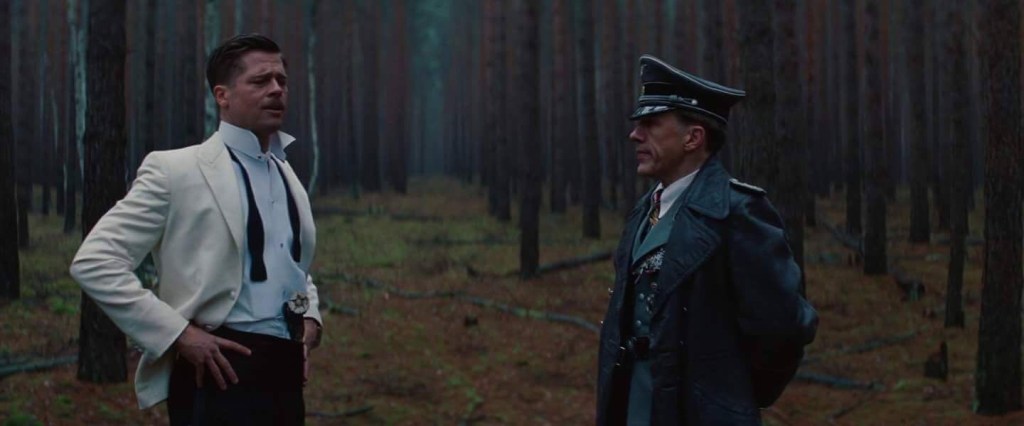
Two men emerge from the mountains to do a job. To defeat their nation’s enemies. One from the Alps, one from the Smokeys. They both enter a world where everyone must pretend to be something they’re not. Their culture, their language, their religion. Their ability to traverse different worlds equates one’s ability to survive.
One man is a chameleon. He can change on a dime and blend in anywhere. One man can’t change. One man emerges victorious.
I think that most people can acknowledge that Inglourious Basterds is one of Tarantino’s best works. It’s impeccably shot, acted, and the dialogue is as virtuosic as of Tarantino’s works. His dialogue is so impeccable that some have compared him to our modern Shakespeare, and Bastards has some of his best conversations, and best lines between characters.
However I think that many have dismissed Basterds as a mere cathartic exercise . A genre piece without thematic depth. I disagreed. There’s always been something floating in the air that I couldn’t quite figure out. Despite Tarantino claiming in interviews and in the final line of Basterds that it is his masterpiece, he doesn’t go out of his way to explain the themes or the subtext that are in his 6th (or 7th depending on how you count) film.
But I think it’s his masterpiece. And I think I’ve finally figured out the subtext that made Inglourious Basterds resonate with me for so many years. I think I can get into it.
Τhere are many a Tarantino quote and interview out there. They’re often about an opinion about another director’s career, or the state of the movie industry. But the quote that always stuck out to me was when he was in the Sundance lab, and he was told to go over the script for Reservoir Dogs, and find the subtext. He did a close reading of the script, and found that it was a father and son story between Mr. White and Mr. Orange. He did the task that Sundance assigned him, then said (to paraphrase) “Great. Now that I know the subtext is there, I never have to do that exercise again.”
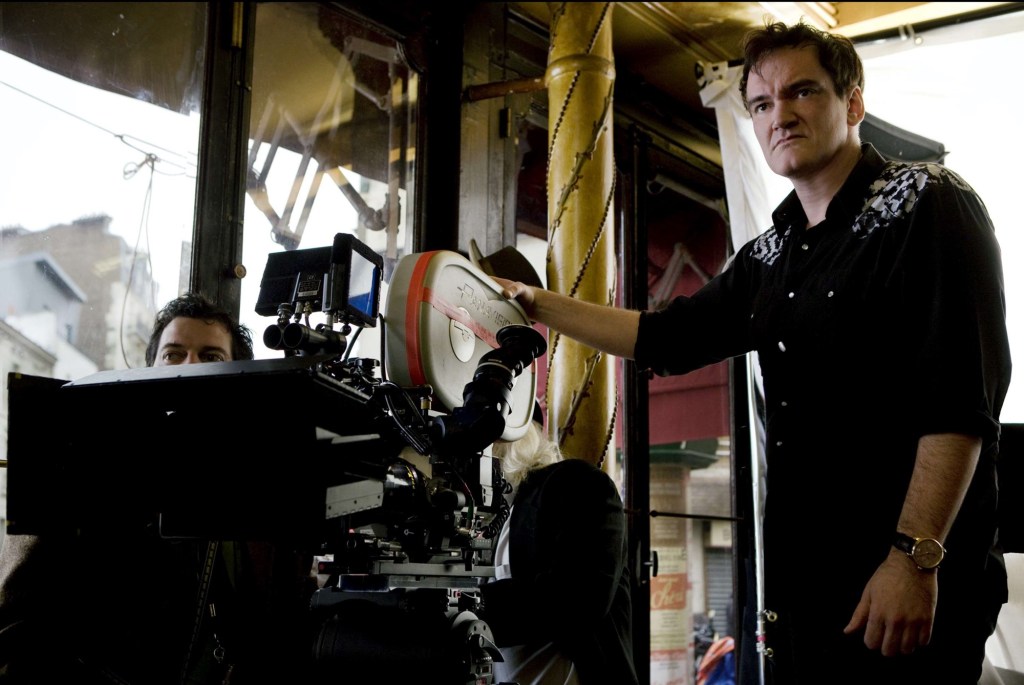
I think that speaks to Tarantino’s philosophy as a writer. Unlike someone like Francis Ford Coppola, who tries to narrow down his themes to one word, and tries to make every scene about that one word theme, Tarantino players with situations. With genre conventions, with history, with personal experience. He’s not preoccupied with the audience understanding the intent behind the words. He’s satisfied to give us an entertaining ride, then let the themes sit in the back of our minds. Gnawing at us. You need to break down the events one by one to find the subtext.
Chapter One Once upon a time… in Nazi-occupied France
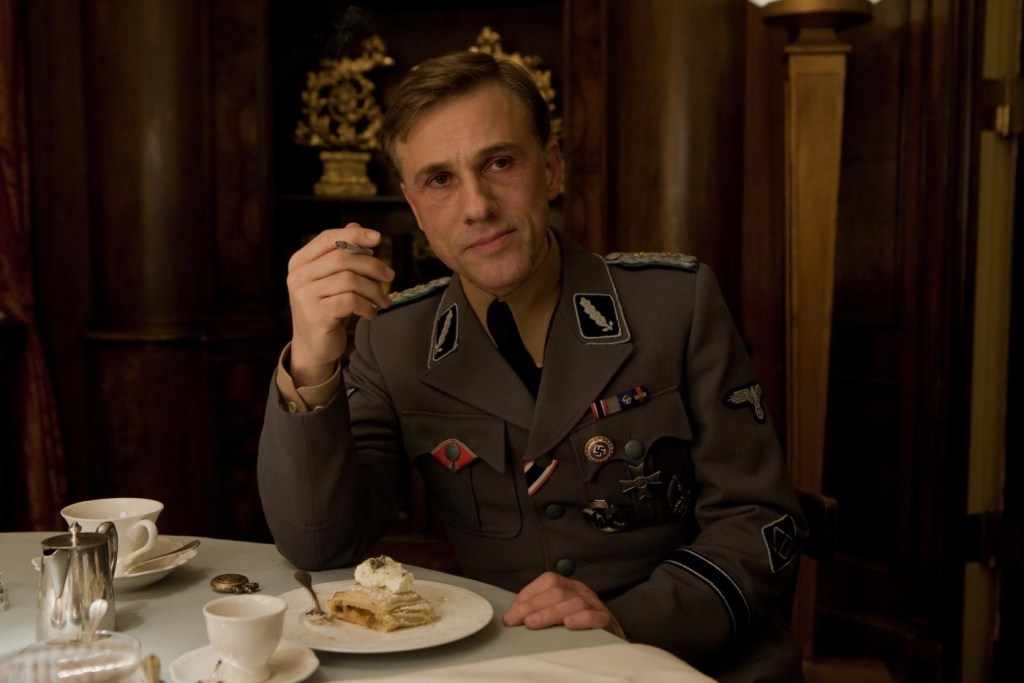
Hans Landa is a chameleon. He walks onto the LaPadite farm like he owns the place, asking for milk, asking the farmer’s daughters to leave the farmhouse. However unlike other German officers, who demand that everything they touch become more German, Landa appears to conform. He is fluent in French and Italian as well as English. Landa has the ability to twist and conform to enemy territory to get the job done.
Unlike the hammer of the Third Reich and its Blitzkreig, Landa is a scalpel. He is a cultured man from the Austrian alps. A cultured place that is in the center of Europe, where people speak German, French and Italian right next door.
In contrast to the rest of the S.S., Alda is a cosmopolitan prosecuting a fascist agenda. He appreciates French culture, cuisine and cigarettes. He admires the Jews. He wants to understand them in order to better kill them.
Chapter Two INGLOURIOUS BASTERDS
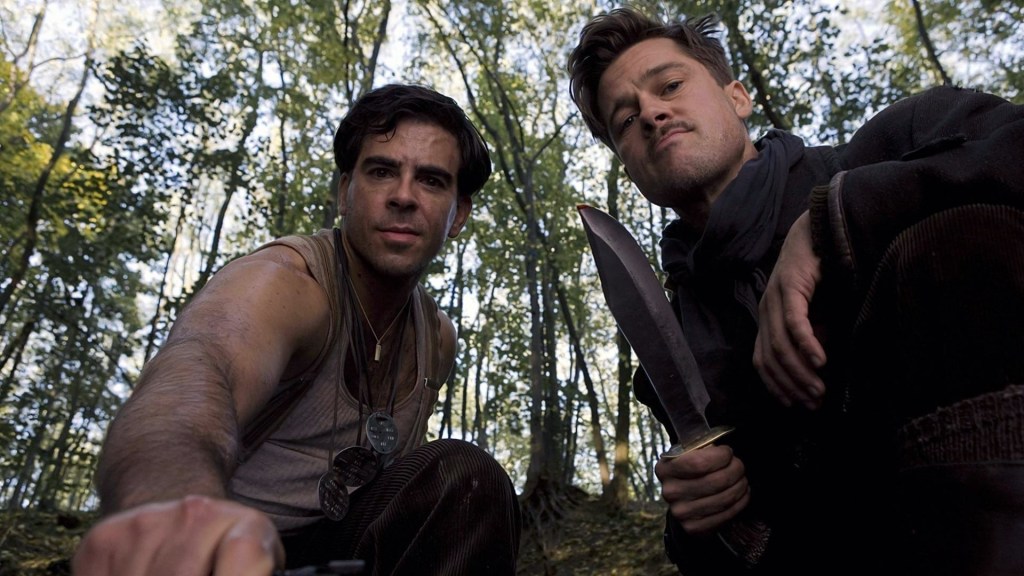
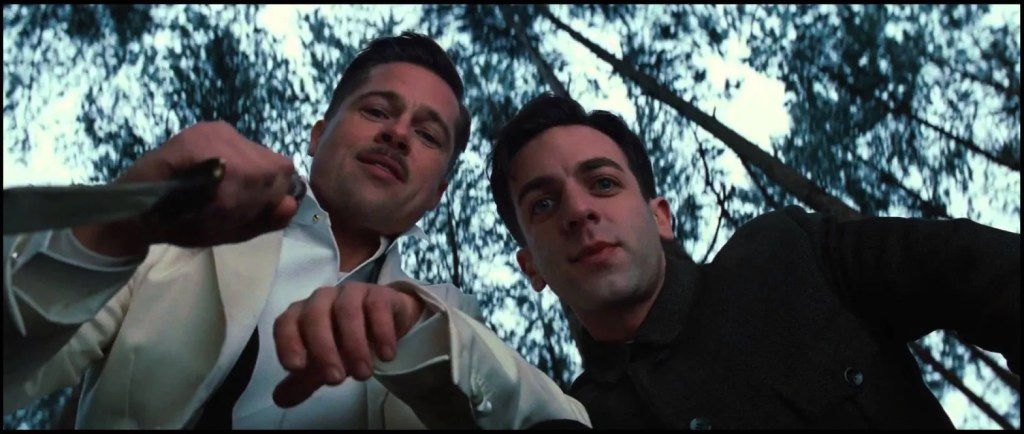
Lieutenant Aldo Raine is exactly what he seems. A Scotts-Irish mountain man from Maynardville Tennessee. He comes from a backwater that the country forgot about. For generations people from the smoky mountains lived isolated in poverty, working in the mines and the mountains and making liquor, to enjoy themselves and make a few extra bucks. He learned his running and gunning tactics from running moonshine, and from his Scottish ancestors before him.
In his introductory monologue, his accent is thick. He and the other Basterds are completely incapable of blending in. They know who they are, and they know their job. Killing nazis. Their outward appearances are conspicuous, and their mission is morally pure and resolute.
Chapter Three GERMAN NIGHT IN PARIS
Shoshana Dreyfus is always hiding who she is. When the Nazi Regime rolled into France, her family went into hiding. A year later, her family is murdered by Landa. She spends the rest of the war hiding in Paris, a Frenchwoman through and through, who must hide both her race and her religion.

Shoshana is as French as French can be. She smokes cigarettes, she flirts, she respects directors, she loves Marcel, her black coworker. She is everything great about cosmopolitan France. That makes her a target of every German who encounters her. It is an old stereotype of Eastern Europe that the military powers of the European plain feel culturally inferior to the bastion of France. At their worst, the Germans and the Russians have wanted to conquer Paris militarily to prove their superiority to the French people.
Enter Fredrick Zoller. A Nazi war hero who wants to win Shoshana’s affection by proving his own cosmopolitanism. He’s a film buff, he’s polite, he’s fluent in French when every other German Shoshana encounters is barking at her in their native tongue, wanting to appreciate her culture, to steal its art and its prestige, while enforcing their iron will over her.
Shoshana is forced to play their game when they ask to use her theater for Goebbels’ film premiere. She temporarily bends to their iron will. She blends in, hiding who she truly is. But she doesn’t reciprocate Zoller’s affection. Her mission, and her morals are pure.
Chapter Four OPERATION KINO
Lieutenant Archie Hicox appears to be as British as a Brit can be. When he enters the briefing room he is the epitome of stiff upper lip. General Ed French and Winston Churchill are in that room to defeat Hitler’s evil empire, and they see Hicox on an even level. Hicox has the moral purity and fortitude to get the job done. But they’ve selected him because they believe he can blend in with the Germans. They believe he’s a chameleon.
Hicox is a film critic. Someone who knows the ins and outs of the German film industry, and who will supposedly blend in perfectly in a German uniform. He is placed with three other spies for a rendezvous in Nadine, France, where they are to pick up movie star and spy, Bridget von Hammersmark.
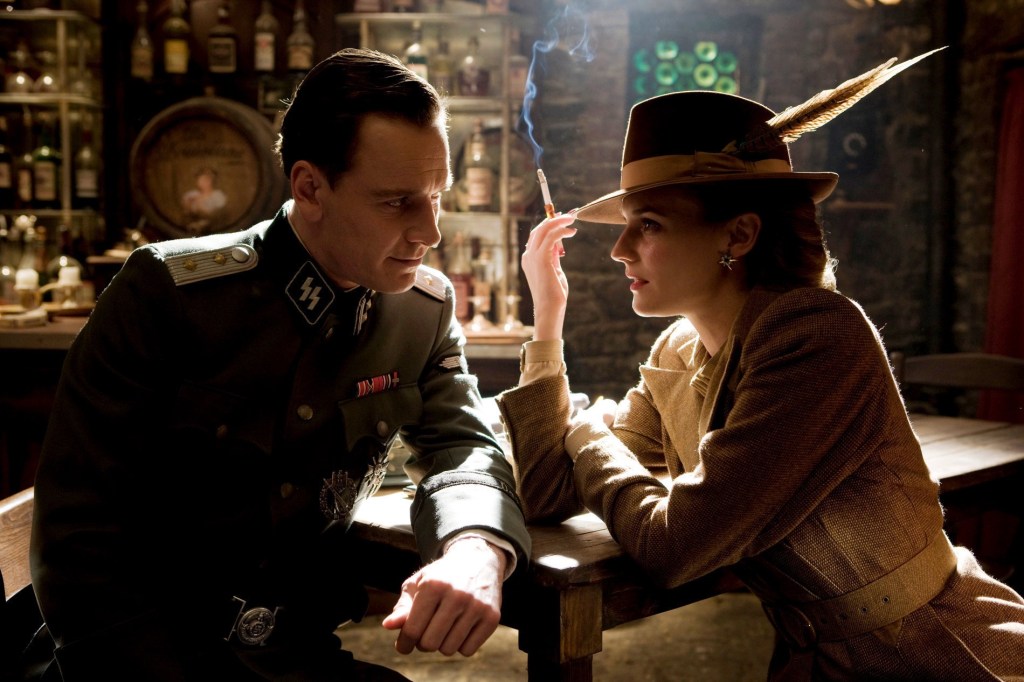
Hammersmark is German through and through, but has a similar moral resolve to the rest of the Basterds, German born and American born alike. He plan is to meet in a tavern, go to the premiere of Zoller’s new film, and blow up the German high command. Aldo questions the plan, who prefers a direct fight to deception, but Hammersmark and Hicox believe they can be in and out.
When the Basterds meet a German squad, drunkenly celebrating in the tavern, one of the most captivating and tense sequences in Tarantino’s filmography ensues. It all hinges on Hicox’s ability to blend in as a German. He almost does it.
Chapter Five REVENGE OF THE GIANT FACE
When Hammersmark failed to get her Anglo-chameleon. To the premier she could’ve given up. She’s a wounded actress, and what remains of the Basterds are a bunch of dumb Americans with thick Appalachian and Boston accents. The task is impossible. But her moral purity and resolve pushes her to keep moving. The Basterds will find a way to do the impossible. Hoping that the Germans won’t have an ear for Italian accents.
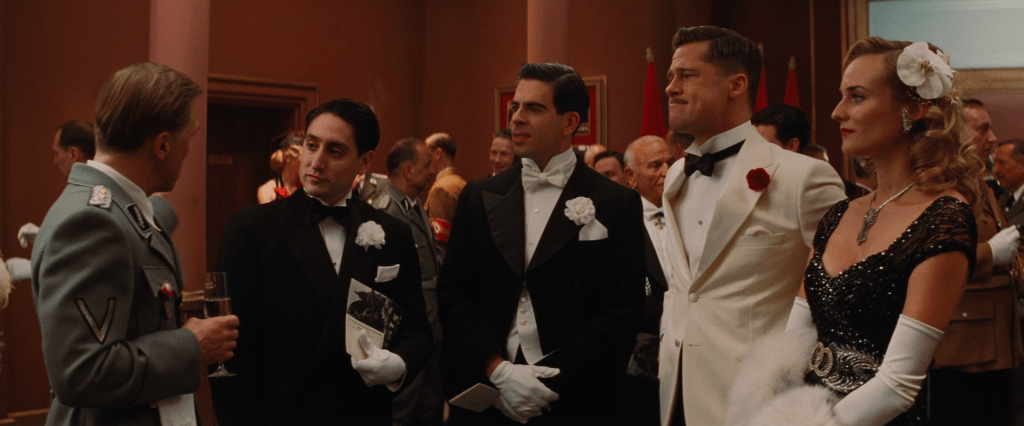
When they arrive, not only are they unable to blend in, they are confronted with the chameleon Hans Landa. Who is able to sniff out any traitor to the Nazi Cause.
Landa kills Hammersmark, captures Rain, yet leaves Sergeant Donowitz and Private Ulmer to complete their task. Landa makes his bet. That he can negotiate his way to a deal where he can get away Scott free. That he can escape justice for his actions. For the Jews he murdered. For the crimes he committed on behalf of Goebbels propaganda machine, and Hitler’s genocidal campaign. He almost does it.
But Landa if facing Lieutenant Aldo Raine. A man who like Hammersmark, like Shoshana, recognizes that while the Nazis may be human, while they may be fathers and lovers and good soldiers, they must be punished for their crimes. By following orders, and becoming “foot soldiers to a Jew-hatin’, mass murderin’ maniac” they’re lost their humanity. And they need to be brought to justice. “They need to be destroyed.”
Landa and Zoller both think that their social positions can be negotiated, and forced through social connections. They think their ability to blend in puts them above their brutish counterparts. They think they’re operating on a level of mutual respect with their Allied counterparts.
But Aldo the Apache and Shoshana Dreyfus don’t operate on that level of mutual respect. They’re willing to die to do what’s right. To hell with niceties.
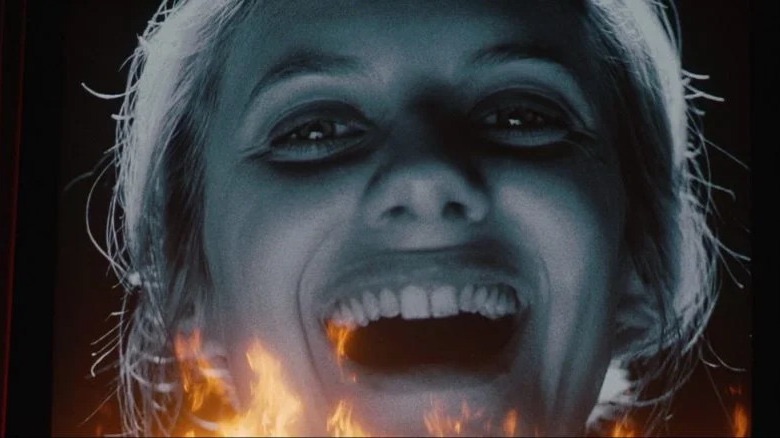
The exercise of reading the subtext of a film may not be necessary to making it. If the author is truly dead, it doesn’t matter what your thematic intentions are. The poetry and the meaning will be found in between the lines.
It takes a great amount of confidence to go forward and write the situation without focusing too much on the themes. But I think that Tarantino figured it out by trusting his gut, and writing what would be satisfying to an audience.
He could’ve come up with a convoluted reason for why the Basterds failed to kill Hitler, but that would not have been satisfying. He could’ve left the situation as it came about, with Landa escaping to Nantucket Island. But that would’ve left the audience un-satiated as well. The Nazis can’t just lose. We need to see them punished. We need to see the fear in their eyes.
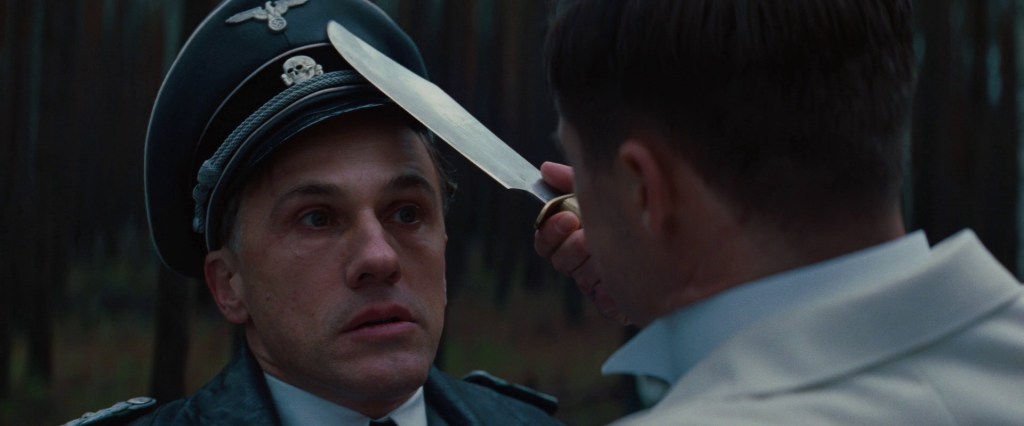
I think Tarantino admires Hans Landa. He’s intelligent, cultured, well read, and wants to be good at his job. But intelligence does not make you a good person. Speaking multiple languages does not mean you share cosmopolitan values. One may think they can squirm out of any situation if they can negotiate, but that would be an immoral universe.
Tarantino gave the audience two counterparts to Hans Landa. A victim out for revenge, and a prosecutor. I think that in Inglourious Basterds he’s saying, intentionally or not, that it is good and right to pursue justice. That understanding those who are different from you is a virtuous trait, but valuing those who are different, and fighting for them, is a moral trait.
I think we need morals in a cruel world.
Even if it’s unnecessary to look for themes in the subtext. I think it’s a virtuous exercise.
 TheFlickReview