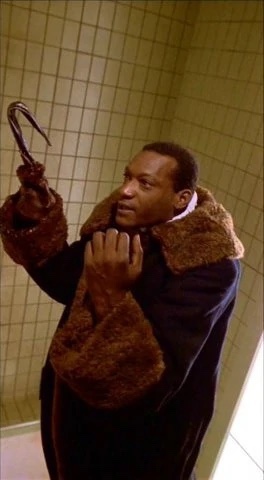
I’m a recent convert to horror. Growing up I was scared of the rumor weed, Larry Boy’s antagonist in the sequel to the fib from outer space. I would hide behind the couch despite constantly rewatching that green VHS. I avoided horror films going forward, perhaps because I have such a visceral reaction to what they’re trying to do, make your skin crawl, make you jump out of you seat.
When I started getting into film, I heard there were a few I needed to see. The Exorcist was among them. I watched it, and loved it. I told myself, “Ok, I like good horror.” Then I watched The Shining, another essential. I told myself, “Ok, I like good horror.” Then I watched John Carpenter’s The Thing. I finally admitted to my self “Oh, I like horror.”
Hence my horror journey began. In no small part due to Jordan Peele. Get Out was a cultural phenomenon that I got swept up in. It had a tight plot, sharp yet simple social commentary, and it scared the shit out of you. The movie invigorated me with the feeling that you could do anything with a movie and still be entertaining. That’s what I seek out when I watch a film. Horror is no exception.
Spoilers below.
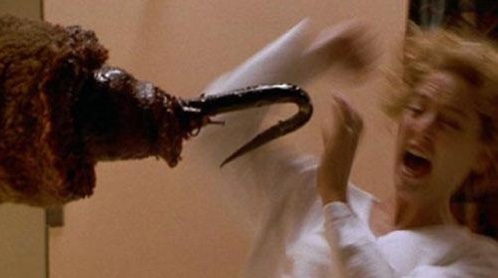
I was excited to see Candyman on the big screen. Directed by up and coming filmmaker Nia DaCosta and written by Peele, DaCosta and, Win Rosenfeld, Candyman is a sequel to the 1992 film of the same name. It seemed to be an exciting, scary film about the Candyman myth, of which I knew nothing about. So I watched the original film for the first time, then saw an advanced screening of the 2021 film. I have a lot of complicated and conflicting feelings about the film. After reading a lot of reviews, including one from Angelica Jade and one from Robert Daniels, two black Chicago critics who were sour on the 2021 film, (they’re very good and linked below) it seems as though a lot of white liberals have uncomplicated feelings about the movie, that DaCosta’s blunt metaphors about American racial politics were enough for white viewers to sing it’s praises, without digging into how or why DaCosta is telling this message in her film.
The original film follows Helen Lyle as she investigates the urban legend of Candyman for her graduate thesis. Lyle, who is white, is dismissive of the myth. Of the Candyman, a black ghoul who haunts the Chicago neighborhood of Cabrini Green. She says that the story is a coping mechanism for black communities to process the terrors of their communities. The Candyman, played by Tony Todd, was originally a painter who was lynched for falling in love with a white patron in the 1890’s. He now haunts people in Cabrini Green to keep his memory alive. So he’s not forgotten.
The film is strange and contradictory. It’s central metaphor is one that explores the enduring legacy of black trauma, and how it still haunts people. Yet the Candyman mostly haunts black people in the film, those who are victims of poverty and neglect. In the end, Helen learns to accept the monster as real, and she eventually haunts and murders those who inflicted trauma on her. The movie is more of a ghost story than a slasher film, though is borrows elements from the latter, especially its gore in later scenes, and the creeping mood that someone is following you. 1992’s Candyman is also a movie about white liberal fears, where Helen is a tourist, merely peering into the trauma of her black neighbors. He distance makes her unable to acknowledge the reality of the trauma of the black community, and her curiosity makes her summon the Candyman, to her and her neighbor’s doom. She cares, but it ultimately takes her death and sacrifice at the Candyman’s hands for her to get over her feelings that the community is something to be observed, and can’t really be helped.
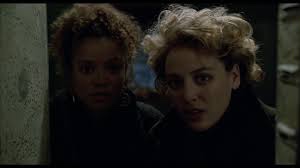
2021’s Candyman is interested in saying so much more than the original intended. It follows Anthony, played by Yahya Abdul-Mateen II, an artist who lives in the gentrifying neighborhoods surrounding Cabrini Green. Anthony lives with his curator girlfriend Brianna, (played by Teyonah Parris) and it trying to maintain his reputation that he can save the black community through art.
Like Helen, Anthony appears to be a visitor to Cabrini Green. He learns of the legend of the Candyman and uses the urban myth to advance his career. Instead of using the poverty and violence of the neighborhood to gain scholarly clout, he uses it to gain artistic clout. At first he doesn’t believe the Candyman is real, but as he learns more and more about the history of the gentrifying neighborhood, he learns how he is connected to the trauma of the past. Eventually, Brianna learns that Candyman is a real manifestation of the trauma of black people in the neighborhood. Specifically of 5 victims of racial violence, including the painter from the 1890’s, a boy who was falsely accused of a crime and was executed by the criminal justice system, a man who moved into a segregated neighborhood and was lynched, a man who was robbed from and killed while buying supplies, and a man who was wrongly accused of putting razor blades in Halloween candy, and was beaten to death by the Chicago PD. Now all versions of Candyman murder people and are reborn in order to… I’m not exactly sure. Because the film makes the metaphor so complicated that it gets the message muddled.
In DaCosta’s retelling, Candyman isn’t just a haunting remembrance of black pain, but a folkloric hero that takes vengeance on the perpetrators of white supremacy. Except when it doesn’t, and when it doesn’t fully explain why the white people who are bad get killed.

I think the central problem in the movie is the strength of the metaphor. DaCosta and company put so much effort into making the myth of Candyman resonant, that they dropped the journey of the characters, and they didn’t focus on scaring the bejesus out of people.
After learning the history of Candyman, Anthony is inspired and makes art about the legend. Anthony shows his art in an art gallery. The piece is a mirror, with gory paintings of racial violence inside. A white art critic says Anthony’s metaphors are blunt and unsophisticated, and that artists are the true gentrifiers of neighborhoods like Cabrini Green. Afterwards, a white asshole art curator tries to have sex in the gallery, and his fling says “Candyman” five times in the mirror. Candyman murders them in a sleek, gory scene, and Anthony gets clout in the news the next day.
Later, the white art critic wants to speak to Anthony because his work has more “relevance” in light of the murders. He gets frustrated that the critic doesn’t understand gentrification and the black experience, and then sees visions of Candyman, (whom he summoned earlier with Brianna.) He leaves, and then the white art critic is murdered in her apartment.
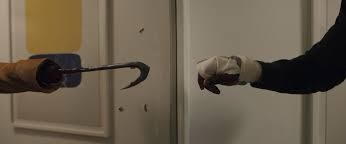
Anthony later learns that he was the baby that was kidnapped by Candyman in the original movie, and that his mother tried to hide that trauma from him growing up. He is then taken by Colman Domingo’s character William Burke, who saws off Anthony’s arm and sticks a hook in it. Burke is haunted by the Candyman because his sister summoned the Candyman and was murdered by him in Cabrini Green, and since he inadvertently caused the death of the man who was falsely accused of putting razor blades into candy. Burke wants Anthony to continue the legacy of Candyman and transforms the artist into a monster.
Brianna, who at this point is the point of view character, is trying to save Anthony, but is captured by the two of them. Burke tries to get Anthony murdered by the cops to continue the legend, but in a chase through the projects, is murdered by Brianna. The cops arrive and murder Anthony and try to get Brianna to lie about what happened. Brianna summons the Candyman, who murders all the cops.
At this point in the movie, a white liberal coworker in my screening started cheering. Brianna used the myth of the Candyman, the memory of violence, to murder the cops that were about to harm her and obscure the truth of the situation and their own violence. The metaphor is powerful, but blunt, unsubtle, and kinda falls apart upon closer inspection.
In the 1992 film, Candyman murders people so people will still believe in him. He’s a haunting violence that wants to reintegrate new stories into his myth so he’ll be remembered. It’s simple.
I know what the 2021 film is trying to say. In the end it’s saying that Candyman is every black man who was murdered by white supremacy, and is enacting revenge on those who perpetuate white supremacy. By remembering and evoking Candyman, Brianna is able to escape police violence, and get justice for what the police did.
But then why was the white art curator murdered? For gentrifying the neighborhood? But it was established that Anthony is also a gentrifier, and anything the white curator did wasn’t direct violence.
Why was the white art critic murdered? For not realizing the intricacies of gentrification and the neighborhood? She understands it better than the art curator though. And she never summoned the Candyman.
There’s a scene in a high school where a bunch of white girls summon the Candyman, following the rules laid out in the original movie, they all get murdered in a tense scene. But then a black girl shows up, and it turns out the white girls have been bullying the black girl. The black girl is spared Candyman’s violence. But this is shown during the scene, rather than having a logical set up and payoff. And this isn’t even getting into the fact that Burke’s sister, (who is black) was murdered by the Candyman for simply summoning him.
It’s all muddled.
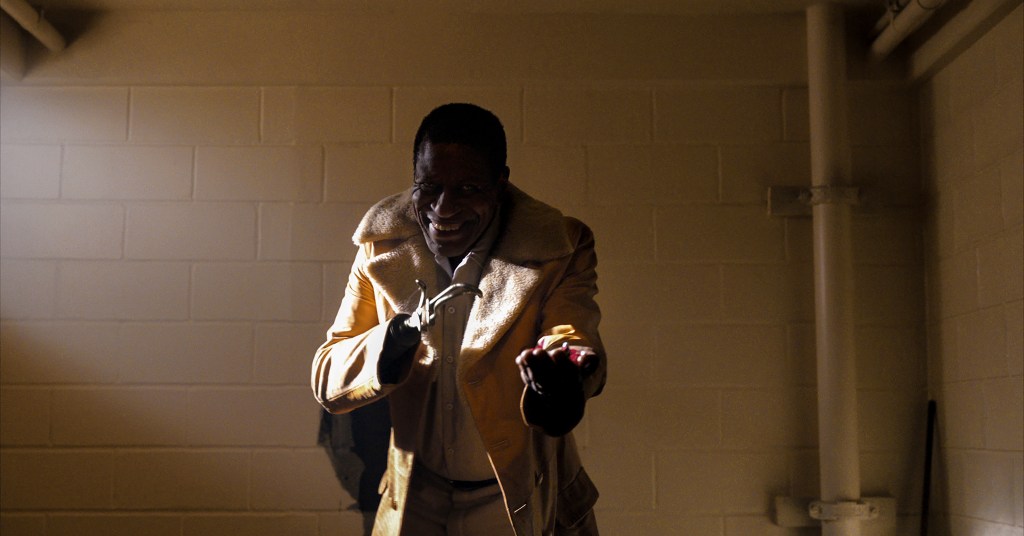
In some scenes the movie is more concerned with getting the metaphor right at the expense of scares, and in others it’s more concerned with scares than with making the metaphor consistent. It has more complicated ideas than the first movie, and at 90 minutes, it has 10 minutes less runtime than the original. The original give the viewer time to marinate in the atmosphere of everything, the performances, the setting, the narrative tension etcetera. In DaCosta’s film, I was constantly thinking “where are they going with this?” rather than “what is going to happen to these characters?”
This brings us back to the white liberal critical response. (Which isn’t exclusively white and liberal of course, but I’m critiquing my own tribe here.) The vast majority of white critics I read on this movie were just repeating the central metaphor in their reviews. They explained what the movie was saying in blunt terms without digging into the how or why of what DaCosta an company are saying.
In my experience, this is a natural white liberal response. We care about racial injustice but recognize that we’ve grown up in a segregated society, and therefore our privileges insulate us from understanding the Intricacies of racism. If we hear someone black say something about race, we jump out of our seats to agree and defend what they’re saying. The limitations of this of course, is that it can be incredibly patronizing. In the most extreme example it can devolve into the “magical mystical negro” trope of black people having supernatural wisdom to impart to us white people.
Reading those articles by Jade and Daniels, it seems as though that’s what a lot of white liberals have done. We eat up the blunt metaphors without digging into how the filmmakers did what they did, and why. Both critics said that the movie was an outsider’s view of Chicago, and merely indicated the ideas of gentrification and the slums into the film, rather than integrating them into the story. (DaCosta, Peele and Rosenfeld are all from New York.)
They also both say that the film fails to focus on scaring the audience. Jade said that “A film such as this should grab hold of your heart, make your skin prickle, cause you to sit at the edge of your seat in panicked fascination. Instead, it glides over you like water rushing over a passing pebble, leaving little mark at all, save for when the didacticism sets in again.” They say that the film isn’t made for horror fans.
They both argue that the film is so blunt and obvious that it designed as a message film for white audiences who don’t know as much about the black experience. They say that the film isn’t made for black people.
Jade goes further to argue that Hollywood has gotten black filmmakers to commodify the horror of black experience and black bodies for white audiences. And that by focusing on white audiences and our un-nuanced understanding of race relations, it reduces black people to bodies rather than to full people.
I’m not sure how much of that I agree with. But the idea makes my skin prickle.
I don’t think 2021’s Candyman is a wholly bad movie. There’s a lot to appreciate and a lot of thought put into the central metaphor. The puppetry scenes are haunting, there are some good set pieces, and good performances, especially from Colman Domingo. I think at the very least it’s interesting to check out. Despite the muddled perspective, I still think DaCosta and company have a perspective that they’re trying to get out there. That more than you can say about a lot of studio movies these days, and I think people who are trying to say something should be financially supported even if they don’t always say it in the most coherent way.
However I’m frustrated by how audiences, especially white liberal audiences are willing to buy into the metaphor without digging into it. I think Candyman indicates a lot of things, but doesn’t always integrate them into the craft of the story they’re trying to tell. I hope as white liberals, we can learn the difference and hold black artists to a more rigorous artistic standard, rather than buying into a well meaning message because it makes us feel like we’re on the right team.
I also hope that DaCosta, Peele and everyone else involved can soon make a movie that’s more focused on scaring the bejesus out of me.
 TheFlickReview